
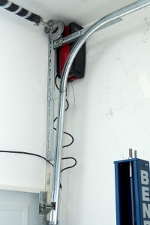
The curved portion of the track on a high lift garage door is above an added piece of vertical track.
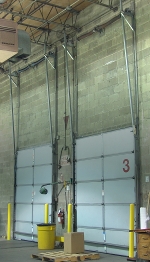
Vertical lift garage doors, shown here, are used frequently in industrial settings. They efficiently use warehouse space when used as dock doors.
The two primary differences are in the track and the cable drums. When a standard-lift garage door is closed, the top roller rests at the bottom of the curved portion of the track, or just below it. High-lift garage doors have a longer straight portion of track between the top roller and the curved portion of the track (as pictured on the left). Vertical lift garage doors do not have any curved portions of the track. Instead, the garage door opens straight up and at a slight angle backward. The track is angled back slightly to let the door close as a wedge, as mentioned on our homepage.
Because the high-lift and vertical-lift garage doors open differently, these systems need different cable drums. Vertical-lift cable drums are not flat like standard-lift cable drums. Instead, the cable continually winds closer to the shaft on the drum as the garage door opens. High-lift cable drums are essentially a mixture of the vertical-lift and standard-lift cable drums. The first few times that the cable wraps around the drum, it moves closer to the shaft like a vertical-lift drum. At a certain point, however, the drum levels out, and the cable continues to wrap around the drum at a constant distance from the shaft like a standard-lift drum.
By using torsion springs that can almost lift the garage door, we are adjusting the net force acting on the door. When the sum of the forces applied to the garage door due to the tension in the cables is close to the force on the door due to gravity, a much smaller applied force (human or opener) is necessary to open the garage door. If the lift of the springs is greater than the weight of the door, the springs will lift the door off of the ground.
When you are sitting on a seesaw and the other person moves toward the middle (the fulcrum), you move toward the ground. In an ideal system, a principle of static equilibrium tells us that F1D1=F2D2, where F corresponds to the weight of the two objects at their respective distances, D, from the fulcrum. Since the weight of the door (F1) and the moment arm of the torsion spring (D2) stay the same but the garage door's moment arm (D1) decreases by a factor of 2 as the cable winds up, the upward force applied by the spring (F2) must also decrease by a factor of 2. Therefore, the upward force necessary to balance the garage door decreases by a factor of 2 as well.
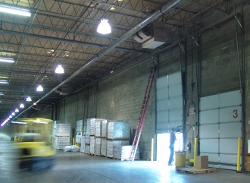
The door will balance because the moment arm decreases as the door opens.
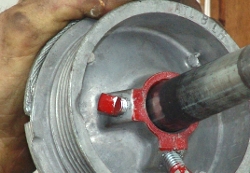
Standard-lift cable drums have a raised groove to help balance the garage door.
Most standard-lift cable drums have a very small portion of high-lift on the outside edge. This was added to cable drums once it was realized that the torsion springs must support the entire weight of the garage door until the top rollers reach the horizontal portion of the track. Although most people are inclined to think that some of the weight will be transferred to the curved portion of the track, this was not consistent with what was practically observed. This raised portion of the standard-lift cable drums allows the garage door to open without the torsion springs losing extra lift in the first portion of the door's travel.
If you are interested in converting from a standard-lift door to a high-lift garage door, see our High-Lift Conversion tutorial. If you have a residential door and you want to convert to a high-lift system, see our High-Lift Inquiry page after gathering the measurements listed in the tutorial to get a quote for a custom conversion kit.