
What Is a Torsion Spring Inside Diameter Conversion?
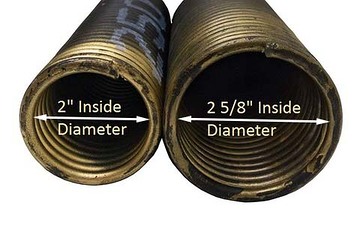
A torsion spring inside diameter (ID) conversion is the process of replacing a garage door torsion spring with one of a different coil diameter while maintaining the same torque, lift properties, and cycle life — because the same length of wire is simply coiled around a larger or smaller rod.
When converting the inside diameter, it is helpful to remember that a torsion spring consists of a given length of wire coiled around a rod. For example, increasing the diameter of the rod reduces the number of times the wire wraps around the rod, hence, shortening the length of the spring. In contrast, the spring will be longer if the inside diameter is reduced. Same amount of wire — same spring weight — same IPPT — same torque — same lift properties.
Cost Savings: Converting from 1 3/4″ ID to 2″ ID Springs
If you currently have 1 3/4″ ID springs, you can save 10% to 25% by converting to 2″ ID springs.
When Should You Convert to a Different Inside Diameter?
There are at least four situations where it is advisable to convert from one inside diameter to another: obsolete hardware, limited shaft space, substituting an available size, and reducing end cone costs.
1. Obsolete Hardware or End Cones
One is when the springs are very old, and the hardware or cones are obsolete, as with some pictured below.
2. Installing Longer-Life Springs on a Crowded Shaft
Another situation is when you may want to install longer-life springs, but there is not enough room on the shaft. Increasing the inside diameter will allow you to install shorter springs with the same longer cycle life.
3. Substituting an Available Spring Size
A third application would include cases where springs with different inside diameters are available, and you need to check whether what's available will work. For example, many doors have 1 3/4″ ID springs, but some door companies carry only 2″ ID springs on their trucks. This converter will provide the length of a 2″ ID spring you will need to install if the broken spring you are replacing has a 1 3/4″ inside diameter.
4. Reducing End Cone Costs
The fourth situation mentioned below is to save on the cost of the end cones. Mass-produced cones cost less than many of the OEM cones.
Step-by-Step: How to Decide Whether to Convert Inside Diameters
Follow these five steps to determine whether an inside diameter conversion is appropriate for your garage door torsion spring replacement.
-
Identify your current spring's inside diameter. The "Current ID" pull-down menu in the converter displays all the inside diameters that have been used on sectional garage doors since manufacturing began.
-
Determine whether replacement cones are still available for that ID. The end cones for many inside diameter springs are obsolete. When converting to a different inside diameter, it is important to convert to a new inside diameter for which cones are made.
-
Check whether sufficient shaft space exists for the replacement spring. If there is not enough room on the shaft, increasing the inside diameter will allow you to install shorter springs with the same longer cycle life.
-
Compare the cost of OEM cones vs. standard cones for the target ID. When considering different inside diameters, remember to factor in the time required to replace the associated torsion hardware.
-
Use the converter tool to find the equivalent spring length in the new ID. Enter your current spring's specifications to calculate the correct replacement length for the target inside diameter.
Which Inside Diameters Are Available for Conversion?
The more common inside diameters include 1 3/4″, 2″, 2 5/8″, 3 3/4″, 5 1/4″, and 6″. OEM cones are also made for 2 1/4″ (Raynor), 3 3/8″ (OHD), 5 1/2″ (Raynor), 5 7/8″ (OHD), and 7 5/8″ (OHD), but these are significantly more expensive.
When converting to a different inside diameter, it is important to convert to a new inside diameter for which cones are made. The cones for springs with OEM inside diameters are much more expensive, and we recommend converting to standard cones when possible.
| Inside Diameter | Cone Type | Availability | Notes |
|---|---|---|---|
| 1 3/4″ | Standard | Widely available | Very common on residential doors; converting to 2″ saves 10–25% |
| 2″ | Standard | Widely available | Most common standard size; mass-produced cones at lower cost |
| 2 1/4″ | OEM — Raynor | Available, higher cost | Recommend converting to standard when possible |
| 2 5/8″ | Standard | Widely available | Common larger residential / light commercial size |
| 3 3/8″ | OEM — OHD | Available, higher cost | Recommend converting to standard when possible |
| 3 3/4″ | Standard | Widely available | Standard dual-wind cones available; pair sells for $46.68 |
| 5 1/4″ | Standard | Widely available | Common commercial size |
| 5 1/2″ | OEM — Raynor | Not available | Recommend converting to 5 1/4″ standard |
| 5 7/8″ | OEM — OHD | Available, higher cost | Recommend converting to standard when possible |
| 6″ | Standard | Widely available | Common large commercial size |
| 7 5/8″ | OEM — OHD | Available, higher cost | Recommend converting to standard when possible |
For example, a pair of the Raynor 3 1/2″ cones cost $186.24; our 3 3/4″ torsion spring cones sell for $46.68. When considering different inside diameters, remember to factor in the time required to replace the associated torsion hardware.
Important Notes Before Converting
This program does not allow you to convert wire sizes to change the strength of your springs or increase your cycle life. Tools for doing this for 1 3/4″, 2″, and 2 1/4″ ID springs are on our Standard Garage Door Torsion Springs page. For other commercial and industrial torsion springs, please contact us.
The "Current ID" pull-down menu displays all the inside diameters that have been used on sectional garage doors since manufacturing began. The end cones for many of these inside diameter springs are obsolete.
Handling Old or Obsolete Springs (Crawford, BarCol, Overhead Door)
If your old, obsolete cones are in good shape, you can usually order new springs to fit them — but it is critical to order the correct springs, as they are not returnable and older springs had unique inside diameters and special ends.
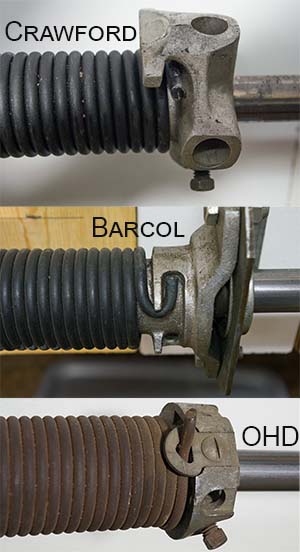
If your old, obsolete cones are in good shape, you can usually order new springs to fit them. It is important to order the correct springs. One reason is that they are not returnable. The other reason is that the older springs had unique inside diameters and special ends.
Special Characteristics by Manufacturer
- Crawford doors: Many of the old Crawford doors have 1 19/32″ I.D. springs, and the ends are extended to lock into the cones.
- BarCol doors: Many of the BarCol springs had 1 13/16″ ID springs, and they are often hooked on the ends.
- Overhead Door (OHD): Overhead Door has springs with bent-up ends that fit into special clips.
Frequently Asked Questions
How much can I save by converting from 1 3/4″ ID to 2″ ID springs?
If you currently have 1 3/4″ ID springs, you can save 10% to 25% by converting to 2″ ID springs.
Can I convert wire sizes to change spring strength using this tool?
No. This program does not allow you to convert wire sizes to change the strength of your springs or increase your cycle life. Tools for doing this for 1 3/4″, 2″, and 2 1/4″ ID springs are on our Standard Garage Door Torsion Springs page. For other commercial and industrial torsion springs, please contact us.
What inside diameters are most commonly available with standard cones?
The more common inside diameters include 1 3/4″, 2″, 2 5/8″, 3 3/4″, 5 1/4″, and 6″. OEM cones are also made for springs with the following inside diameters: 2 1/4″ (Raynor), 3 3/8″ (OHD), 5 1/2″ (Raynor), 5 7/8″ (OHD), and 7 5/8″ (OHD). The cones for springs with these inside diameters are much more expensive, and we recommend converting to standard cones when possible.
Why are some OEM cones more expensive than standard cones?
The cones for OEM inside diameters are much more expensive. For example, a pair of the Raynor 3 1/2″ cones cost $186.24; our 3 3/4″ torsion spring cones sell for $46.68. Mass-produced cones cost less than many of the OEM cones.
What happens to spring length when I increase the inside diameter?
Increasing the diameter of the rod reduces the number of times the wire wraps around the rod, hence, shortening the length of the spring. In contrast, the spring will be longer if the inside diameter is reduced. Same amount of wire — same spring weight — same IPPT — same torque — same lift properties.
Can I reuse my old cones if they are in good shape?
If your old, obsolete cones are in good shape, you can usually order new springs to fit them. It is important to order the correct springs. One reason is that they are not returnable. The other reason is that the older springs had unique inside diameters and special ends. For example, many of the old Crawford doors have 1 19/32″ I.D. springs, and the ends are extended to lock into the cones. Many of the BarCol springs had 1 13/16″ ID springs, and they are often hooked on the ends. Overhead Door has springs with bent-up ends that fit into special clips.
What are the special spring characteristics of old Crawford, BarCol, and Overhead Door systems?
Many of the old Crawford doors have 1 19/32″ I.D. springs, and the ends are extended to lock into the cones. Many of the BarCol springs had 1 13/16″ ID springs, and they are often hooked on the ends. Overhead Door has springs with bent-up ends that fit into special clips.